Lost Vape URSA NANO Review: Controls, Signals and Unmeasured Claims
A simple interface is not a test result. We examine the original URSA NANO's documentation to distinguish physical controls, battery signals and unverified performance claims.
Key points
- This is a documentation review, not a hands-on product test.
- Electrical control and airflow adjustment perform different jobs.
- Status indications do not replace measured performance evidence.
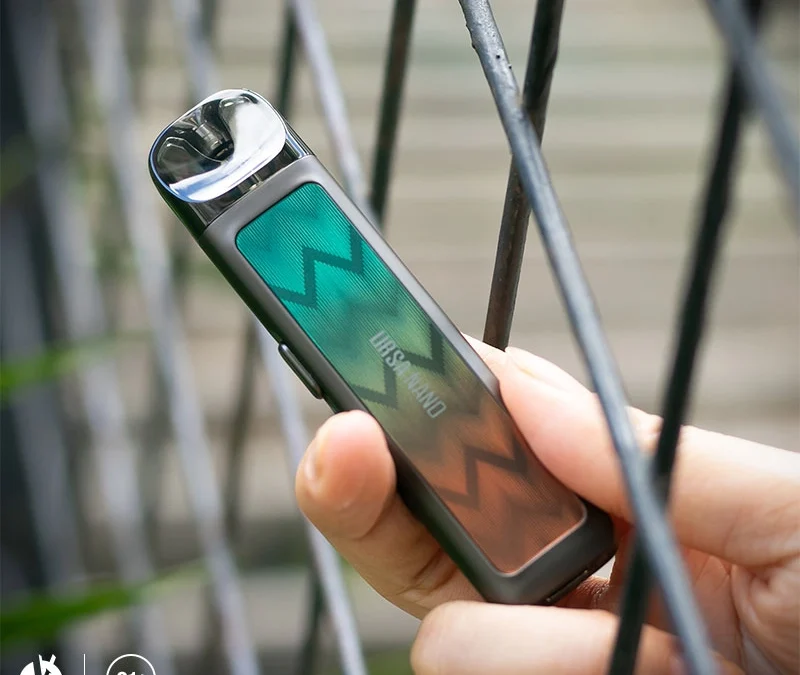
The original Lost Vape URSA NANO has a deliberately sparse interface. That makes it a useful case study in the difference between a product specification and a product verdict. This is an independent review of the manufacturer’s documentation, not a hands-on test; no numerical score is assigned.
Start with the boundaries
Lost Vape lists an 800mAh built-in battery, a 5–18W power range and a 2.5ml refillable pod in the standard kit on the original model’s product page. Those figures describe different parts of the system, not one combined measure of performance. Battery capacity does not establish a daily runtime, and the upper power limit is not proof of a constant output throughout a charge.
The page also describes automatic coil-resistance detection and an airflow slider. Our reading is that electrical control and airflow control should be assessed separately: a sliding air inlet changes a physical opening, while detecting resistance is an electronic function. Neither statement tells us how consistently a particular sample responds. The website’s leakage and all-day endurance claims remain manufacturer claims here, rather than conclusions adopted by this review.
Model names also matter: this assessment concerns the original URSA NANO only. It should not be used as a specification sheet for later numbered versions, whose names are similar. Official product documentation
The manual provides a clearer vocabulary
The manual separates the mouthpiece, pod, refill plug, airflow control, LED and Type-C port in its diagram. That component map is more useful for understanding the interface than describing the device as simply buttonless. It shows that a reduced number of operating controls does not eliminate separate liquid, airflow and charging interfaces.
Its battery information is voltage-based: the colour guide uses boundaries at 3.7V and 3.9V, while the low-battery protection description distinguishes a 3.3V threshold before use from a 3.0V threshold during use. Colour is therefore a coarse status signal, not a percentage display. The manual also distinguishes an absent atomizer from a short circuit and lists an automatic cutoff after a draw longer than ten seconds. These descriptions explain intended signalling and limits; they are not independent verification that every protection operates as specified. Official user manual
What this review can conclude
On paper, the strongest subject for assessment is the division of responsibilities: the pod, airflow control, indicator and battery each do something different. A genuine performance review would still need measured output, charging observations, repeated leakage checks and recorded battery-runtime conditions. Until those tests exist, a modest specification-based conclusion is more credible than a star rating.
Sources
18+ only. This site is for adult readers and provides news and information only. It is not medical, legal or purchase advice. Nicotine is addictive. Always check the official text of any regulation in your market. Health Information